
PANDORE
Creation 2026
From 6 years old
Pandore, the first woman in Greek mythology, created by Zeus to punish mankind, possesses all manner of gifts, including that of curiosity. By opening the ‘box’, Pandora unleashes plagues and curses upon the world, with the exception of ‘hope’…
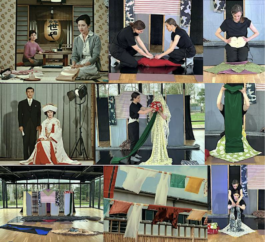
PANDORE is a textile ritual performed as a duet, which uses movement to evoke the magic of apparitions. Two women, clearly bound by sisterhood, perform a naturalistic choreographic sequence centred on the folding and unfolding of various fabrics, themselves contained within furoshikis*
Through their interplay, they work to construct a shifting pictorial space, whether abstract or not. A continuum of precise gestures sets the textiles in motion, revealing various landscapes, forms and figures – plant, animal or human…
A dreamlike space in constant transformation, where black and white gives way to a colourful tableau… Pandora, or the dream of fabric!
PANDORE offers a first glimpse into the work of the Japanese filmmaker Yasujirō Ozu.
This duo is also, and above all, designed for non-dedicated spaces. It is aimed at audiences of all ages, from young people to adults.
*Furoshiki is a traditional Japanese technique for folding and tying fabric, used for wrapping gifts and carrying various everyday objects.
PANDORE is a duet that serves as a precursor to a work based on the cinematic grammar of the filmmaker Yasujirō Ozu, in preparation for the quartet HIGANBANA, which is due to premiere in autumn 2027.
Conceived as a self-contained and versatile work, intended particularly for young audiences, this duo draws its inspiration from the world of the Japanese filmmaker:
In the second half of his career, Ozu’s cinema centred on the portrayal of the family – a ‘pretext’ for exploring the passage of time … and for focusing on an innovative cinematic form. Ozu also invented the ‘tatami’ shot (a shot framed at the eye level of a seated dog).
In his films, the family is often portrayed through the daily rituals of living together: eating or drinking, folding or unfolding clothes, getting dressed, packing or unpacking a suitcase… all of which constitute recurring motifs, interspersed with shots of objects, landscapes or still lifes – veritable paintings with meticulously composed frames that lend the film its rhythm.
At the crossroads between a study of the movement of family figures in Ozu’s cinema and his quasi-pictorial compositions, Pandore invents a choreographic form akin to a soothing ritual. A maelstrom of unfurled fabrics and simple gestures unfolding in stretched-out time transform this moment into a shared ceremony, a small elegy to the passing of time.
The set design, comprising in particular furoshikis (which originate from Japan), reveals a collection of fabrics chosen for their visual qualities (designer fabrics or upcycled materials)… and deliberately left in their raw state, as a nod to wabi-sabi: ‘an aesthetic that advocates a return to simplicity, a peaceful restraint capable of positively influencing existence, where one can recognise and feel the beauty of imperfect, ephemeral and modest things’ (source: Wikipedia).
In Ozu’s cinema, everything revolves around the human condition, which is symbolised in Greek mythology by Pandora’s act.
For whilst Pandora releases terrible evils from the box, she retains ‘Elpis’, which we translate as ‘hope’ or ‘expectation’ but whose primary meaning is ‘waiting’ – a concept that defines what makes us human.
Emmanuelle Vo-Dinh – April 2026
HIGANBANA
Concept and scenography Emmanuelle Vo-Dinh
Choreography and dance Violette Angé, Alexia Bigot, Sabine Macher, Emmanuelle Vo-Dinh
Light design casting in progress
Music Olyphant
Production PAVILLON-S, Emmanuelle Vo-Dinh
Partners Le Théâtre, Scène nationale de St Nazaire, Ballet du Nord - CCN & Vous!, in Progress...
Pavillon-s is supported by the Ministère de la culture – DRAC de Normandie, the Région Normandie, the Département de l’Eure, the Ville de Rouen et the Département de Seine-Maritime.
concept and scenography Emmanuelle Vo-Dinh
choreography and interpretation Violette Angé, Alexia Bigot
music David Olyphant Monceau
production Pavillon-s
coproduction (in progress) Ballet du Nord - CCN & Vous!, Le Lux – Scène Nationale de Valence, Dance Cork Firkin Crane…
With the support of Spedidam
duration 30 minutes
Creation at the Centre André Malraux in Rouen from June 29 to July 4 2026.
HIGANBANA
Création automne 2027
en recherche de coproducteurs
HIGANBANA met en scène quatre femmes déployant une même partition aux temporalités différentes. Composé à partir d’actions du quotidien entrecoupées de représentations d’affects, ce quatuor travaille poétiquement la question du passage à travers la figure féminine…laquelle se révèle selon l’expérience des 4 femmes d’âges différents en présence au plateau.
Le processus d’écriture d’HIGANBANA puise dans la grammaire du réalisateur japonais Yasujiro Ozu* : le travail du mouvement, de la voix, de la lumière, du cadre, propres au cinéaste, deviennent le terrain d’un jeu de règles ciné-chorégraphique.
Pour autant, il ne s’agit pas de retranscrire une œuvre cinématographique au plateau, mais de s’emparer de sa matière plastique, architecturale, naturaliste… pour tenter de mettre en œuvre une forme stylistique qui répond à sa façon, au concept d’impermanence (concept prégnant au Japon qui privilégie l’instant, le caractère éphémère de chaque chose)*. La question du rituel, de la transformation dans la répétition, de ses variations temporelles, viennent figurer des présences chorégraphiques qui tendent vers l’épure….
Plutôt qu’une histoire superficielle je préfère montrer des choses cachées, plus profondes, l’instabilité des choses humaines, j’ai préféré laisser des espaces vides comme un arrière-goût plaisant. -Yasujiro Ozu
Un univers plastique très présent, s’élaborera à partir d’une réflexion sur le cadre, la lumière, et viendra architecturer ces images-tableaux dans une pure visée émotionnelle, tandis que la bande son déploiera des climats musicaux contrastés voire parfois hétéroclites.
Ainsi, les espaces de silence et de respiration propres à la filmographie d’Ozu, mais aussi le jeu des actrices et acteurs de ses films, ou bien encore l’approche symbolique de chaque détail scénographique, suggèrent un espace de fiction à inventer, où se joue en creux un travail sur les émotions et leurs silences.
Emmanuelle Vo-Dinh
*Ce projet fait l’objet d’une candidature à la villa Kujoyama-Kyoto en 2025 pour une résidence en 2026.
HIGANBANA
Concept and scenography Emmanuelle Vo-Dinh
Choreography and dance Violette Angé, Alexia Bigot, Sabine Macher, Emmanuelle Vo-Dinh
Light design casting in progress
Music Olyphant
Production PAVILLON-S, Emmanuelle Vo-Dinh
Partners Le Théâtre, Scène nationale de St Nazaire, Ballet du Nord - CCN & Vous!, in Progress...
Pavillon-s is supported by the Ministère de la culture – DRAC de Normandie, the Région Normandie, the Département de l’Eure, the Ville de Rouen et the Département de Seine-Maritime.
concept and scenography Emmanuelle Vo-Dinh
choreography and interpretation Violette Angé, Alexia Bigot
music David Olyphant Monceau
production Pavillon-s
coproduction (in progress) Ballet du Nord - CCN & Vous!, Le Lux – Scène Nationale de Valence, Dance Cork Firkin Crane…
With the support of Spedidam
duration 30 minutes
Creation at the Centre André Malraux in Rouen from June 29 to July 4 2026.