
Creations 2023, ...
© Laure Delamotte-Legrand
© Laure Delamotte-Legrand
For the past six years, I have been interested in different aspects of cinema to nourish and build my choreographic work.
For example, the piece Cocagne, created in 2018, draws its material from a film montage I made from various films, mixing fiction, documentaries, images found on the internet, etc., which deal with the question of representation in its polysemic dimension.
Working more specifically on Eisenstein's cinema (Battleship Potemkin for Cocagne, then on the same filmmaker's theory of montage), I continued this research for the creation of Attractions in 2021, bringing into play a choreographic work that borrows from and draws its raison d'être from film editing, both visual and sound.
This back-and-forth between choreography and cinema led me to make (modestly and without any particular technical background) various short films used for some of my performances created in situ (Cocagne click&collect, Hôtel Flaubert-Rouen, at the invitation of the Frac-Normandie Rouen, as part of the exhibition désentimentaliser).
With the ARCANES project, a collection of short films, the cinematographic challenge I am tackling is different, drawing its source not from editing, but from the question of framing and the mise en abîme that this notion raises:
I have often noticed that we are incapable of looking at what is in front of us unless it is in a frame. Abbas Kiarostami
Abbas Kiarostami's latest film, 24 frames, is thus a starting point for the work of ARCANES paysages, a choreographic trio that is written in the light of the different types of landscape in which it is set, and whose first opus took place on 3 July 2022 at the Moulin d'Andé (ARCANES paysage, Mont Saint-Michel created in April 2023 on the Couesnon dam).
Each performance brings into play different frames placed or suspended in spaces chosen with regard to the choreography.
ARCANES paysages is thus conceived as a continuous creation, with the performance being choreographically renewed according to the invitations and spaces it occupies.
Within this body of work, the first short films in the ARCANES collection, EVERSO and MIRARI, are conceived as a filmic translation capable of poeticising the setting once again, through the treatment of the image itself and the nature of the places in which they operate.
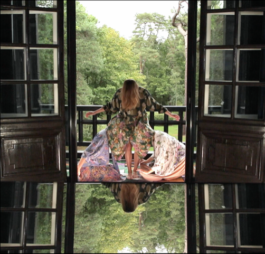
Filmed in a fixed shot, EVERSO is a contemplative choreographic work between immobility and movement, which takes place on a balcony where three women weave a sequence of pauses, inviting the viewer to perceive a succession of living tableaux. As they move within this confined space, they gradually open different bay windows, inviting the viewer to renew their gaze in the light of the new frame that emerges. The dramaturgical progression works to abolish narration, shifting towards a strangeness of presences that evolve at a slightly slowed pace, while the presence of a cat with its natural motor skills randomly provides a counterpoint, like another reality.
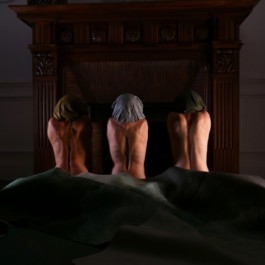
Inspired by a performance staged in nature, the choreography and rhythm of MIRARI were developed to echo the elements of the landscape in which the performance was created and performed. Thus, rivers, plants, wind and wildlife contributed to the organic nature of the movement, while the sound design (field recordings of animals and insects, guttural and vocal sounds, and modular synthesizer) weaves bridges between tension and attention. By offering a new setting for the choreography (that of a strange temple-like chimney), the nature of the landscape becomes something else entirely... a mental landscape above all else.
ARCANES, short films collection
EVERSO
director Emmanuelle Vo-Dinh
director of photography and editing Laure Delamotte-Legrand
music Olyphant
Light design Max Sautai
movement writing and performance Violette Angé, Alexia Bigot, Emmanuelle Vo-Dinh
with the participation of Miku
costumes Emmanuelle Vo-Dinh
production manager Solenne Racapé
duration 25 minutes 42
production Pavillon-s
Partner Le Phare CCN du Havre Normandie, Dieppe Scène Nationale, Centre chorégraphique national de Rillieux-la-Pape – direction Yuval Pick.
With the supported of l’Onda, office national de diffusion artistique dans le cadre du dispositif Écran vivant
Trois femmes sur un balcon oscillent entre attente et étrange rituel chorégraphique, lequel vient jouer du renversement, tant dans l’image en miroir intégrant le cadre, que de la frontière opérant entre intérieur et extérieur. Dans l’espace entre-deux de ce balcon aux architectures en mouvement, EVERSO propose un voyage pictural et sensoriel… à sa fenêtre.
MIRARI
director Emmanuelle Vo-Dinh
director of photography and editing Laure Delamotte-Legrand
music Olyphant
Light design Max Sautai
movement writing and performance Violette Angé, Alexia Bigot, Emmanuelle Vo-Dinh
costumes Emmanuelle Vo-Dinh
production manager Solenne Racapé
duration 15 minutes 58
production Pavillon-s
Partner Le Phare CCN du Havre Normandie, Dieppe Scène Nationale, Centre chorégraphique national de Rillieux-la-Pape – direction Yuval Pick.
With the supported of l’Onda, office national de diffusion artistique dans le cadre du dispositif Écran vivant Pavillon-s est subventionné par le Ministère de la culture – direction générale de la création artistique, la Région Normandie, le Département de l'Eure, le Département de Seine-Maritime et la Ville de Rouen.
Scheudle
Filming from 28 August to 2 September 2023 at Fruit Intégral, in Andé
Preview screening on 18 January 2024 at Cinéma Tati – Le Théâtre, Saint-Nazaire's national theatre, as part of the Trajectoires festival.
Continuous screening of MIRARI from 15 to 18 May 2024, 10 a.m. to 7 p.m., at the Historial Jeanne d'Arc in Rouen, as part of Curieux printemps.
Continuous screening of MIRARI and EVERSO on 20 and 21 September 2025 at the Moulin d'Andé as part of WEI!
Creations 2023, ...
© Laure Delamotte-Legrand
© Laure Delamotte-Legrand
For the past six years, I have been interested in different aspects of cinema to nourish and build my choreographic work.
For example, the piece Cocagne, created in 2018, draws its material from a film montage I made from various films, mixing fiction, documentaries, images found on the internet, etc., which deal with the question of representation in its polysemic dimension.
Working more specifically on Eisenstein's cinema (Battleship Potemkin for Cocagne, then on the same filmmaker's theory of montage), I continued this research for the creation of Attractions in 2021, bringing into play a choreographic work that borrows from and draws its raison d'être from film editing, both visual and sound.
This back-and-forth between choreography and cinema led me to make (modestly and without any particular technical background) various short films used for some of my performances created in situ (Cocagne click&collect, Hôtel Flaubert-Rouen, at the invitation of the Frac-Normandie Rouen, as part of the exhibition désentimentaliser).
With the ARCANES project, a collection of short films, the cinematographic challenge I am tackling is different, drawing its source not from editing, but from the question of framing and the mise en abîme that this notion raises:
I have often noticed that we are incapable of looking at what is in front of us unless it is in a frame. Abbas Kiarostami
Abbas Kiarostami's latest film, 24 frames, is thus a starting point for the work of ARCANES paysages, a choreographic trio that is written in the light of the different types of landscape in which it is set, and whose first opus took place on 3 July 2022 at the Moulin d'Andé (ARCANES paysage, Mont Saint-Michel created in April 2023 on the Couesnon dam).
Each performance brings into play different frames placed or suspended in spaces chosen with regard to the choreography.
ARCANES paysages is thus conceived as a continuous creation, with the performance being choreographically renewed according to the invitations and spaces it occupies.
Within this body of work, the first short films in the ARCANES collection, EVERSO and MIRARI, are conceived as a filmic translation capable of poeticising the setting once again, through the treatment of the image itself and the nature of the places in which they operate.
Filmed in a fixed shot, EVERSO is a contemplative choreographic work between immobility and movement, which takes place on a balcony where three women weave a sequence of pauses, inviting the viewer to perceive a succession of living tableaux. As they move within this confined space, they gradually open different bay windows, inviting the viewer to renew their gaze in the light of the new frame that emerges. The dramaturgical progression works to abolish narration, shifting towards a strangeness of presences that evolve at a slightly slowed pace, while the presence of a cat with its natural motor skills randomly provides a counterpoint, like another reality.
Imaginé à partir d’une performance réalisée dans la nature, l’écriture chorégraphique de MIRARI, ainsi que sa rythmicité, ont été travaillé en écho aux éléments du paysage dans laquelle cette performance a été créé et joué. Ainsi, fleuve, végétaux, vent, et faune sauvage ont contribué à nourrir l’organicité du mouvement, tandis que la création sonore (enregistrements en field recording d’animaux et insectes, de voix gutturales et buccales et synthétiseur modulaire) tisse des passerelles entre tension et attention. En proposant un nouveau cadre à la chorégraphie (celui d’une étrange cheminée aux allures de temple), la nature du paysage devient tout autre …un paysage mental avant tout.
ARCANES, short films collection
EVERSO
director Emmanuelle Vo-Dinh
director of photography and editing Laure Delamotte-Legrand
music Olyphant
Light design Max Sautai
movement writing and performance Violette Angé, Alexia Bigot, Emmanuelle Vo-Dinh
with the participation of Miku
costumes Emmanuelle Vo-Dinh
production manager Solenne Racapé
duration 25 minutes 42
production Pavillon-s
Partner Le Phare CCN du Havre Normandie, Dieppe Scène Nationale, Centre chorégraphique national de Rillieux-la-Pape – direction Yuval Pick.
With the supported of l’Onda, office national de diffusion artistique dans le cadre du dispositif Écran vivant
Trois femmes sur un balcon oscillent entre attente et étrange rituel chorégraphique, lequel vient jouer du renversement, tant dans l’image en miroir intégrant le cadre, que de la frontière opérant entre intérieur et extérieur. Dans l’espace entre-deux de ce balcon aux architectures en mouvement, EVERSO propose un voyage pictural et sensoriel… à sa fenêtre.
MIRARI
director Emmanuelle Vo-Dinh
director of photography and editing Laure Delamotte-Legrand
music Olyphant
Light design Max Sautai
movement writing and performance Violette Angé, Alexia Bigot, Emmanuelle Vo-Dinh
costumes Emmanuelle Vo-Dinh
production manager Solenne Racapé
duration 15 minutes 58
production Pavillon-s
Partner Le Phare CCN du Havre Normandie, Dieppe Scène Nationale, Centre chorégraphique national de Rillieux-la-Pape – direction Yuval Pick.
With the supported of l’Onda, office national de diffusion artistique dans le cadre du dispositif Écran vivant Pavillon-s est subventionné par le Ministère de la culture – direction générale de la création artistique, la Région Normandie, le Département de l'Eure, le Département de Seine-Maritime et la Ville de Rouen.
Scheudle
Filming from 28 August to 2 September 2023 at Fruit Intégral, in Andé
Preview screening on 18 January 2024 at Cinéma Tati – Le Théâtre, Saint-Nazaire's national theatre, as part of the Trajectoires festival.
Continuous screening of MIRARI from 15 to 18 May 2024, 10 a.m. to 7 p.m., at the Historial Jeanne d'Arc in Rouen, as part of Curieux printemps.
Continuous screening of MIRARI and EVERSO on 20 and 21 September 2025 at the Moulin d'Andé as part of WEI!