
HIGANBANA
Creation Automn 2027
With HIGANBANA, I continue a meticulous exploration of the instantaneous composition of spaces to contemplate, using deliberately modest means and emphasizing a collective approach to the creative process. Echoing the state of the world, the driving force behind HIGANBANA —a Japanese flower symbolizing a moment of transition or passage— lies in the intentional creation of poetic, fragile, and sensitive spaces, choreographically inhabited by four women of different ages and backgrounds.
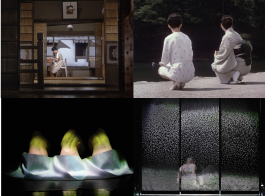
The writing process for HIGANBANA draws on the grammar of Japanese filmmaker Yasujiro Ozu: the treatment that he applies to movement, voice, light, and framing provides the playground for a set of cinematic-choreographic rules.
Through a precise choreographic ritual, a pictorial or even cinematic space emerges live before the eyes of the audience, using various mobile frames and assembled fabrics.These small, miniature “theaters,” crafted in plain sight, are offered to the viewer, each time generating a new choreographic fiction in which the feminine takes center stage.
Composed of ritualized everyday actions, this quartet poetically explores the notion of passage—as a time of crossing— recalling the work of Penelope. While the aim is not to transpose a purely cinematic work onto the stage, the intention is to embrace the sculptural, architectural, and naturalistic qualities at the heart of Ozu’s oeuvre, in an attempt to develop a stylistic form that, in its own way, responds to the concept of impermanence—a central notion in Japan that values the present moment and the ephemeral nature of all things.
The range of silence and breathing that belongs to Ozu’s filmography, the distinctive performance style he demanded of his actors, as well as the symbolic approach to every scenographic detail all suggest a fictional space to be invented, where a subtle exploration of emotions and their silences unfolds.
Emmanuelle Vo-Dinh
HIGANBANA
Concept and scenography Emmanuelle Vo-Dinh
Choreography and dance Violette Angé, Alexia Bigot, Sabine Macher, Emmanuelle Vo-Dinh
Light design Françoise Michel
Music Olyphant
Production PAVILLON-S, Emmanuelle Vo-Dinh
Partners Le Théâtre, Scène nationale de St Nazaire, Ballet du Nord - CCN & Vous!, in Progress...
Pavillon-s is supported by the Ministère de la culture – DRAC de Normandie, the Région Normandie, the Département de l’Eure, the Ville de Rouen et the Département de Seine-Maritime.
Rehearsals (schedule in progress)
November 3-7th 2025 - Fruit Intégral, Andé (France)
From January 30 to February 20th 2026 - Preparatory trip in Japan
March 9-13th 2026 - Fruit Intégral, Andé (France)
April 27-30 2026 - Fruit Intégral, Andé (France)
June 8,9,10th 2026 - Fruit Intégral, Andé (France)
October 5-9th 2026 - Ballet du Nord, CCN de Roubaix
February 8-12th 2027 - La Briqueterie, CDCN du Val-de-Marne
May 10-14th 2027 - Le Phare CCN du Havre
August 23-27th 2027 - Dance Cork Firkin Crane
Automn 2027 - Japan residencies (in progress)
December 2027 - creation
HIGANBANA
Creation Automn 2027
With HIGANBANA, I continue a meticulous exploration of the instantaneous composition of spaces to contemplate, using deliberately modest means and emphasizing a collective approach to the creative process. Echoing the state of the world, the driving force behind HIGANBANA —a Japanese flower symbolizing a moment of transition or passage— lies in the intentional creation of poetic, fragile, and sensitive spaces, choreographically inhabited by four women of different ages and backgrounds.
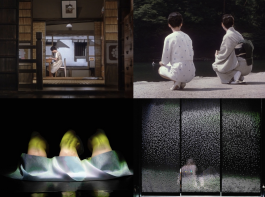
The writing process for HIGANBANA draws on the grammar of Japanese filmmaker Yasujiro Ozu: the treatment that he applies to movement, voice, light, and framing provides the playground for a set of cinematic-choreographic rules.
Through a precise choreographic ritual, a pictorial or even cinematic space emerges live before the eyes of the audience, using various mobile frames and assembled fabrics.These small, miniature “theaters,” crafted in plain sight, are offered to the viewer, each time generating a new choreographic fiction in which the feminine takes center stage.
Composed of ritualized everyday actions, this quartet poetically explores the notion of passage—as a time of crossing— recalling the work of Penelope. While the aim is not to transpose a purely cinematic work onto the stage, the intention is to embrace the sculptural, architectural, and naturalistic qualities at the heart of Ozu’s oeuvre, in an attempt to develop a stylistic form that, in its own way, responds to the concept of impermanence—a central notion in Japan that values the present moment and the ephemeral nature of all things.
The range of silence and breathing that belongs to Ozu’s filmography, the distinctive performance style he demanded of his actors, as well as the symbolic approach to every scenographic detail all suggest a fictional space to be invented, where a subtle exploration of emotions and their silences unfolds.
Emmanuelle Vo-Dinh
HIGANBANA
Concept and scenography Emmanuelle Vo-Dinh
Choreography and dance Violette Angé, Alexia Bigot, Sabine Macher, Emmanuelle Vo-Dinh
Light design Françoise Michel
Music Olyphant
Production PAVILLON-S, Emmanuelle Vo-Dinh
Partners Le Théâtre, Scène nationale de St Nazaire, Ballet du Nord - CCN & Vous!, in Progress...
Pavillon-s is supported by the Ministère de la culture – DRAC de Normandie, the Région Normandie, the Département de l’Eure, the Ville de Rouen et the Département de Seine-Maritime.
Rehearsals (schedule in progress)
November 3-7th 2025 - Fruit Intégral, Andé (France)
From January 30 to February 20th 2026 - Preparatory trip in Japan
March 9-13th 2026 - Fruit Intégral, Andé (France)
April 27-30 2026 - Fruit Intégral, Andé (France)
June 8,9,10th 2026 - Fruit Intégral, Andé (France)
October 5-9th 2026 - Ballet du Nord, CCN de Roubaix
February 8-12th 2027 - La Briqueterie, CDCN du Val-de-Marne
May 10-14th 2027 - Le Phare CCN du Havre
August 23-27th 2027 - Dance Cork Firkin Crane
Automn 2027 - Japan residencies (in progress)
December 2027 - creation